

The immune system protects the body against microorganisms through two major branches: innate immunity and adaptive immunity. Both systems recognize foreign material and contribute to the elimination of infections, but they differ in their recognition mechanisms.
Adaptive immunity uses highly specific receptors on B lymphocytes and T lymphocytes to recognize antigens. In contrast, innate immunity recognizes conserved molecular structures associated with microorganisms and certain signals released by damaged cells.
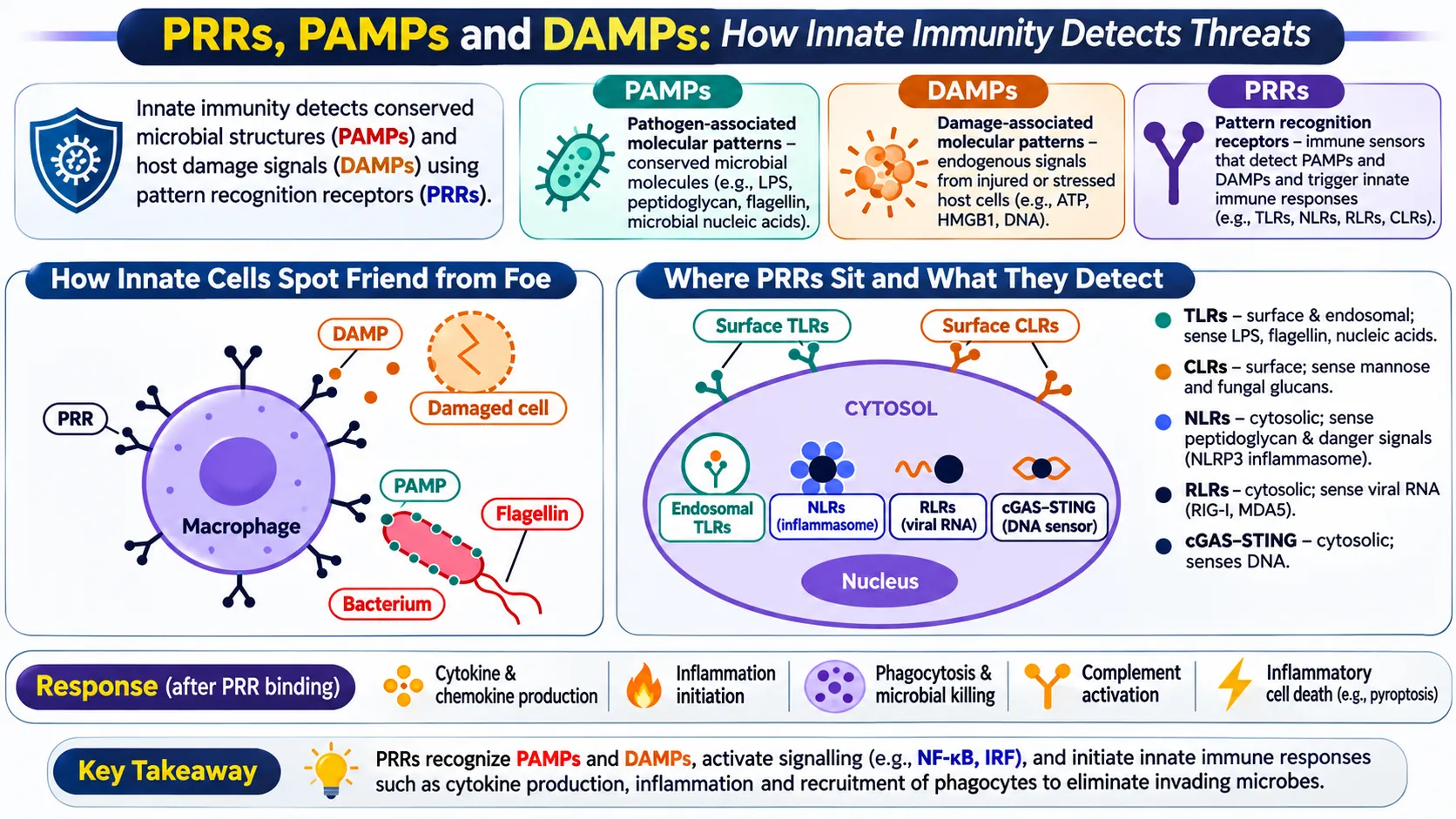
Two important components of this process are pathogen-associated molecular patterns (PAMPs) and pattern recognition receptors (PRRs). PAMPs are microbial molecular structures, while PRRs are recognition molecules that detect these structures and initiate or support innate immune responses.
Understanding the relationship between PAMPs and PRRs helps explain how the body detects infection, initiates inflammation, and activates mechanisms that eliminate invading microorganisms.
1. What Are PAMPs?
Pathogen-associated molecular patterns (PAMPs) are conserved molecular structures found in many microorganisms. These structures may be present in microbial cell walls, membranes, flagella or nucleic acids.
Examples of PAMPs include:
- Lipopolysaccharide (LPS): A component of the outer membrane of Gram-negative bacteria.
- Peptidoglycan: An important structural component of most bacterial cell walls.
- Bacterial lipoproteins: Molecules that can be recognized by specific innate immune receptors.
- Flagellin: A protein that forms the filament of many bacterial flagella.
- Microbial nucleic acids: Certain forms of viral RNA and microbial DNA that can be detected by innate immune sensors.
These structures are useful targets because many are conserved among groups of microorganisms. The innate immune system can therefore detect broad classes of microbes without needing to identify every microbial species individually.
However, PAMPs are not exclusive to harmful pathogens. Harmless microorganisms may also possess these structures. For this reason, the term microbe-associated molecular patterns (MAMPs) is sometimes used when referring to microbial structures regardless of whether the organism causes disease.
Recognition also depends on the molecular structure, location and context in which a microbial component is detected. Not every microbial molecule automatically triggers inflammation.
2. What Are Pattern Recognition Receptors (PRRs)?
Pattern recognition receptors are molecules involved in the recognition of microbial structures and other signals relevant to innate immunity. They are expressed by various cells, including macrophages, neutrophils, dendritic cells and epithelial cells.
PRRs recognize PAMPs and, in some cases, damage-associated molecular patterns (DAMPs), which are signals associated with injured or stressed host cells.
Following recognition, PRRs can activate intracellular signalling pathways that stimulate the production of cytokines, chemokines, interferons and other antimicrobial molecules. Depending on the receptor and stimulus, recognition can also promote phagocytosis, complement-related defence or inflammatory cell death.
PRRs and related recognition molecules can be discussed in three broad groups according to their location and function:
- Cell-surface and endosomal receptors.
- Cytoplasmic microbial sensors.
- Soluble recognition molecules in blood and tissue fluids.
These groups cooperate to detect microorganisms in different locations and initiate appropriate immune responses.
3. Cell-Surface PRRs: Recognizing Microbes Outside Cells
Cell-surface PRRs are located in the plasma membrane and detect microbial components outside the cell. Examples include certain Toll-like receptors (TLRs). Other surface receptors, such as mannose receptors and scavenger receptors, can contribute to microbial recognition and uptake.
3.1 Recognition and phagocytosis
Macrophages and other phagocytic cells can recognize and engulf microorganisms through several receptor-mediated mechanisms.
For example, when a macrophage binds to a bacterium and takes it inside, the bacterium becomes enclosed in a membrane-bound compartment called a phagosome. The phagosome matures and can fuse with lysosomes, forming a compartment containing digestive enzymes and antimicrobial substances.
These substances help destroy the microorganism and break it down into smaller components.
This process is known as phagocytosis.
3.2 Recognition and inflammatory signalling
Some cell-surface receptors primarily activate signalling pathways rather than directly engulfing microbes.
For example, TLR4 recognizes bacterial LPS with the help of accessory proteins. Its activation can stimulate pathways involving NF-κB, leading to the production of inflammatory cytokines.
These cytokines help coordinate the immune response and can recruit additional immune cells to the site of infection.
Thus, microbial recognition at the cell surface can contribute to both pathogen uptake and the activation of immune signalling. The precise outcome depends on the receptor and the cell involved.
4. Intracellular PRRs: Detecting Microbial Components Inside Cells
Microorganisms may enter host cells, and microbial components can become accessible within the cytoplasm or intracellular compartments. The immune system therefore requires sensors that detect microbial material inside cells.
Important examples include NOD-like receptors (NLRs), RIG-I-like receptors (RLRs), and certain endosomal TLRs.
4.1 NOD-like receptors (NLRs)
NOD-like receptors are intracellular sensors that recognize particular microbial components or changes associated with infection and cellular stress.
For example, NOD2 recognizes muramyl dipeptide, a fragment derived from bacterial peptidoglycan. Recognition activates signalling pathways, including those involving NF-κB, which can promote the production of inflammatory mediators.
Another member of this receptor family, NLRP3, can respond to a range of cellular disturbances associated with infection or tissue damage.
When appropriately activated, NLRP3 assembles a multiprotein complex called an inflammasome. This complex activates caspase-1, which promotes the maturation and release of interleukin-1β (IL-1β) and interleukin-18 (IL-18).
Inflammasome activation can also trigger pyroptosis, an inflammatory form of programmed cell death, under suitable conditions.
These mechanisms help the immune system respond to intracellular disturbances and coordinate inflammation.
4.2 Intracellular Toll-like receptors (TLRs)
Not all TLRs are located on the cell surface. Certain TLRs are present on endosomal membranes, where they detect microbial nucleic acids taken into the cell.
Examples include:
- TLR3: Recognizes double-stranded RNA.
- TLR7 and TLR8: Recognize particular forms of single-stranded RNA.
- TLR9: Recognizes DNA containing characteristic unmethylated CpG motifs.
Activation of these receptors initiates signalling pathways that can promote cytokine production and, in appropriate cellular contexts, type I interferon production.
Type I interferons are particularly important in antiviral defence. They help establish an antiviral state in cells and coordinate immune responses against viral infections.
The distinction is important: NLRs are cytoplasmic sensors, whereas these TLRs detect microbial material within intracellular compartments such as endosomes.
5. Soluble Recognition Proteins: Detecting and Tagging Microbes
Microbial recognition does not depend entirely on receptors attached to cells. Blood and tissue fluids contain soluble proteins that bind microorganisms and help the immune system eliminate them.
Some soluble recognition proteins activate the complement system, while others promote opsonization or support the removal of microbes and damaged cellular material.
Two important examples are mannose-binding lectin (MBL) and C-reactive protein (CRP).
5.1 Mannose-binding lectin (MBL)
Mannose-binding lectin is a soluble protein produced mainly by the liver and released into the bloodstream. It recognizes particular arrangements of sugar residues, including mannose-rich structures, on the surfaces of many microorganisms.
When MBL binds to a suitable microbial surface, it interacts with associated enzymes called MBL-associated serine proteases (MASPs). These enzymes initiate the lectin pathway of complement activation.
The complement cascade then produces molecules that can:
- Coat microbes and promote their uptake by phagocytes.
- Generate inflammatory mediators that help recruit and activate immune cells.
- Form the membrane attack complex, which can damage susceptible microbial membranes.
MBL therefore connects microbial recognition with several mechanisms of innate immune defence. Importantly, it can activate the lectin pathway without requiring an antigen-specific antibody.
5.2 C-reactive protein (CRP)
C-reactive protein is an acute-phase protein produced mainly by the liver. Its concentration in the blood can increase substantially during inflammation, particularly in response to cytokines such as IL-6.
CRP binds to certain molecular structures, including phosphocholine, on microbial surfaces and some damaged cells. Once bound, it can interact with C1q, a component of the classical complement pathway.
This interaction can promote complement activation and facilitate the clearance of microbes or cellular debris. CRP can also contribute to opsonization, helping phagocytes recognize and remove its targets directly or through complement components.
Although CRP can activate the classical complement pathway, it is not an antibody and does not have the antigen-specific receptor structure characteristic of adaptive immunity.
6. What Happens After Microbial Recognition?
Recognition is the starting point of an integrated immune response. Different mechanisms cooperate to control infection.
Major outcomes of PAMP recognition
1. Phagocytosis: Phagocytic cells engulf microorganisms and digest them inside intracellular compartments.
2. Inflammation: Inflammatory mediators help recruit immune cells and increase local defensive activity.
3. Cytokine and chemokine production: These signalling molecules coordinate communication between immune cells and influence the intensity and location of the response.
4. Interferon production: Certain receptors detect viral nucleic acids and stimulate interferon responses that help limit viral replication.
5. Complement activation: Complement proteins coat microbes, enhance inflammation and, in some cases, damage microbial membranes.
6. Inflammatory cell death: Specific intracellular sensors can activate pathways such as inflammasome-mediated pyroptosis.
Not every PRR triggers all these outcomes. The response depends on the receptor, the type of microbial signal, the cell involved and the surrounding conditions.
7. Innate Immunity vs Adaptive Immunity
| Feature | Innate immunity | Adaptive immunity |
|---|---|---|
| Recognition | Conserved microbial patterns and other danger signals | Specific antigens |
| Main recognition molecules | PRRs and other innate recognition proteins | B-cell receptors (BCRs) and T-cell receptors (TCRs) |
| Response to first exposure | Usually rapid | Usually slower during the primary response |
| Specificity | Recognizes broad classes of molecular patterns | Highly specific for particular antigenic structures |
| Memory | Can show trained immunity, but generally lacks classical antigen-specific memory | Develops antigen-specific immunological memory |
The difference between innate and adaptive immunity is not simply the type of cell involved. A central distinction is how recognition occurs and how receptor specificity is established.
Innate immune recognition relies heavily on receptors that detect conserved patterns or danger signals. Adaptive immune recognition relies on highly diverse antigen receptors generated by B and T lymphocytes.
The two systems are closely connected. For example, dendritic cells can recognize microbes through innate receptors, process microbial proteins and present peptide antigens to T cells. This helps initiate an adaptive immune response.
Conclusion
PAMPs and PRRs are central to the early recognition of microorganisms by the innate immune system. PAMPs are conserved microbial structures, while PRRs detect these structures and initiate or support defensive mechanisms.
Cell-surface receptors detect microbial components outside cells, intracellular sensors recognize microbial material within cells, and soluble recognition proteins such as MBL and CRP help activate complement and promote microbial clearance.
Together, these mechanisms support phagocytosis, inflammation, cytokine production, antiviral defence and other antimicrobial responses. By recognizing broad molecular patterns, innate immunity provides an early defence while helping activate the more antigen-specific adaptive immune response.
Frequently Asked Questions (FAQs)
1. What is the difference between PAMPs and PRRs?
PAMPs are conserved molecular structures found in many microorganisms. PRRs are recognition molecules that detect PAMPs and initiate or support innate immune responses.
2. What are some examples of PAMPs?
Examples include bacterial LPS, peptidoglycan, bacterial lipoproteins, flagellin and certain forms of microbial RNA and DNA.
3. What are the main types of PRRs?
Important PRR families include Toll-like receptors (TLRs), NOD-like receptors (NLRs), RIG-I-like receptors (RLRs) and C-type lectin receptors. Soluble proteins such as MBL and CRP also contribute to innate microbial recognition, although they are not all classified as cellular PRRs in the strict sense.
4. What is the role of NOD-like receptors?
NOD-like receptors are intracellular sensors that detect particular microbial components or cellular disturbances. Depending on the receptor, they can activate inflammatory signalling or assemble inflammasomes.
5. How does mannose-binding lectin help eliminate microbes?
MBL binds to particular sugar patterns on microbial surfaces and activates the lectin pathway of complement. This promotes opsonization, inflammation and microbial clearance.
6. What is the role of CRP in innate immunity?
CRP binds to certain structures on microbes and damaged cells. It can promote complement activation and help phagocytes remove microbes or cellular debris.
7. Are PAMPs found only in harmful pathogens?
No. PAMPs can also occur in harmless microorganisms. Their presence alone does not necessarily mean that a microorganism will cause disease.
8. Why is innate immunity important for adaptive immunity?
Innate immune cells, especially dendritic cells, help initiate adaptive immunity by processing antigens, presenting them to T cells and providing signals required for effective lymphocyte activation.